How to Evaluate Rust Cheats Before You Buy a Private Cheat Menu
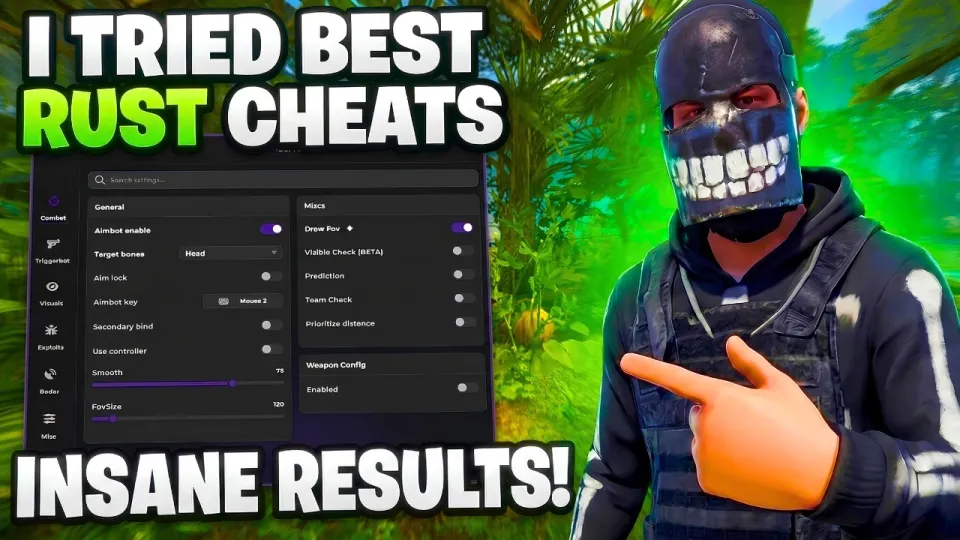
Video: I Secretly Used Rust Cheat To Dominate Everyone In The Server...(INSANE)
· based on the channel yqzkqrv
Key takeaways
- The ZALIANT Private Rust Cheat is sold as a single product page at zaliantservices.com for PC Rust.
- The showcase video by yqzkqrv runs through the menu, features, settings and gameplay in roughly one minute of footage.
- Core feature categories in modern Rust cheats are ESP (player, loot, stash), aimbot with smoothing, and a configurable cheat menu.
- Rust runs Easy Anti-Cheat, so any cheat purchase carries a real risk of a game ban and account loss.
- Private cheats are typically priced higher than public ones and are sold in limited batches rather than openly.
Rust cheats are third-party software modifications that give a player information or aiming advantages in Rust, usually through an ESP overlay, an aimbot and a configurable menu. Before spending money, judge a cheat by what its menu actually exposes, how the settings behave in real gameplay, and what detection and account-ban risk you accept by running it on a Facepunch server. The private cheat featured in yqzkqrv's showcase, sold on the ZALIANT Private Rust Cheat product page, is a useful example of how such a package is presented.
What a private Rust cheat menu typically contains
A private cheat menu is the in-game overlay where every feature is toggled and tuned, and it is the first thing to inspect in any showcase. In the ZALIANT walkthrough the presenter opens the menu before any gameplay starts, which is the correct order: the interface tells you more about a cheat than a highlight clip ever will. Look for these building blocks:
- ESP / wallhack modules. Player boxes, skeletons, names, distance readouts, and separate toggles for loot, dropped bags, stashes and vehicles. Good menus let you filter by item type and set a maximum render distance so the screen does not turn into noise.
- Aimbot settings. Target bone selection (head, chest, nearest), field-of-view cone, smoothing or humanization sliders, visibility checks and a hotkey to hold rather than a permanent lock.
- Miscellaneous utilities. No-recoil or recoil compensation, silent or memory-based aiming variants, fast loot, and movement helpers.
- Configuration management. Named configs, per-feature keybinds, and the ability to save a setup so it can be reloaded after a restart.
- Stream-proof options. Overlay hiding so the menu does not appear in captures, which matters if you record or stream.
A menu that exposes only an on/off switch per feature gives you no way to look less obvious, and in Rust that is the difference between a long-lived account and a short one.
Reading a cheat showcase critically
The value of a Rust cheat showcase lies in the settings screens and unedited gameplay, not in the kill feed. The yqzkqrv video is short: the intro and menu showcase open the clip, a features overview follows, the bulk of the runtime is gameplay footage, and it closes with a final review. That structure is standard for this genre, and it tells you what to watch for.
- Pause on the settings screens. Note which sliders exist and whether values look conservative (low FOV, high smoothing) or extreme.
- Watch the crosshair, not the kills. Smooth tracking and natural flicks suggest a usable aimbot configuration; instant snapping suggests the opposite.
- Check what the ESP draws. Boxes on every player across the map are a red flag for both performance and plausibility.
- Treat highlight edits with suspicion. Fast cuts hide deaths, bans and stutters. A one-minute video cannot prove stability across a wipe.
How Rust cheats get detected
Rust is protected by Easy Anti-Cheat, and detection is the single largest cost of cheating, far above the price of the software. Easy Anti-Cheat runs as a kernel-level service on Windows, scans memory and loaded modules, and reports signatures and behaviour to Facepunch. On top of that, Rust has server-side and player-side layers: admins review reports, spectators can watch suspicious players, and Facepunch issues game bans that remove access to official servers.
Practical consequences for anyone considering a Rust hack:
- A ban is applied to the account and the copy of Rust on it; a new copy and a new Steam account are needed to play official servers again.
- "Undetected" is a statement about the moment of sale, not a guarantee. Cheat providers push updates after detection waves, and there is always a window where users are exposed.
- Server owners can ban locally even when the anti-cheat has not acted, and community blacklists are shared.
- Hardware and IP bans are used selectively, so a ban can follow you beyond one account.
Any product page that promises permanent undetected status is overselling; the honest framing is update frequency and support responsiveness after a detection.
Pricing, access and support questions to ask
The commercial side of Rust cheats matters as much as the feature list, because private software is usually sold in limited quantities and priced well above public options. When you look at a storefront such as zaliantservices.com, get clear answers to these before paying:
- What is the licence length? Monthly, lifetime, or per-wipe. Compare the cost against the price of a new Rust account, since a ban resets both.
- How are updates delivered? Look for a changelog with dates and a stated turnaround after Rust patches, which land monthly and often break cheats.
- Is there a support channel? The provider runs a Discord community where buyers typically get build announcements and troubleshooting.
- What are the system requirements? Windows version, Secure Boot and TPM state, and whether antivirus exclusions are needed.
- What is the refund policy? Most cheat sellers refuse refunds after delivery, so treat the purchase as final.
Cheap Rust cheats exist, but they are usually public builds with wide signatures, shared by thousands of users and detected quickly. A private build costs more precisely because fewer people run it.
Matching cheat settings to how you actually play
Legit-style configuration is the difference between a cheat that survives a wipe and one that ends in a report within an hour. If you study any Rust cheat gameplay footage, translate what you see into numbers you can reason about:
- Aimbot FOV: keep the cone narrow, roughly 3–8 degrees, so the assist only engages targets you are already tracking.
- Smoothing: high values spread the correction over many frames; low values look robotic in spectator view.
- ESP distance: render players at 150–250 metres rather than across the whole map, and disable loot ESP in open areas where a real player would not notice items.
- Recoil control: partial compensation is less conspicuous than perfect spray patterns, which are trivial to spot in a death cam.
- Hotkeys: bind every active feature to a key you can release instantly, and keep a panic key that unloads the overlay.
None of this removes the risk; it only changes how quickly other players and admins notice you. The aimbot and ESP categories in a cheat menu are also the ones anti-cheat developers target hardest, so the newest and least documented features are usually the most dangerous to enable.
Final verdict on private Rust cheats
A private Rust cheat is a paid subscription to an advantage plus a standing risk to your account, and the yqzkqrv breakdown shows the standard shape of that trade: a compact menu, an ESP and aimbot feature set, and a short gameplay segment that demonstrates the software rather than proving it safe. Judge any package by the depth of its settings, the honesty of its update policy and the quality of its support, not by a highlight reel. If you decide the risk is acceptable, start from the ZALIANT Private Rust Cheat page, read the licence terms and update notes first, and treat every wipe as a fresh detection cycle. The video breakdown on the yqzkqrv channel is worth watching for the menu tour alone, provided you watch it with the caveats above in mind.
Questions & answers
Are Rust cheats undetected?
No cheat can be permanently undetected. Rust uses Easy Anti-Cheat, which scans memory and loaded modules and acts in waves, so any build is exposed eventually. Providers advertise "undetected" status at the time of sale and ship updates after patches, but a ban risk always remains.
What features does a typical Rust cheat menu include?
Most menus combine ESP or wallhack modules for players, loot and stashes with an aimbot that has adjustable FOV, smoothing and target bone. Extras usually cover recoil control, fast loot, movement helpers, keybinds and saved configs, plus stream-proof overlay hiding.
How much do private Rust cheats cost compared to public ones?
Private cheats are priced higher than public builds because access is limited to fewer users, which keeps signatures rarer. Expect monthly or lifetime licences rather than one-off cheap keys, and factor in the cost of replacing a banned Rust account when comparing prices.
What happens if you get banned for cheating in Rust?
Facepunch issues a game ban that blocks official servers on that account, and the copy of Rust on it becomes unusable for those servers. Community server owners can also ban locally and share blacklists, and hardware or IP bans are used in some cases.
Source: I Secretly Used Rust Cheat To Dominate Everyone In The Server...(INSANE) · Markdown version